Light-Up Paper Creatures


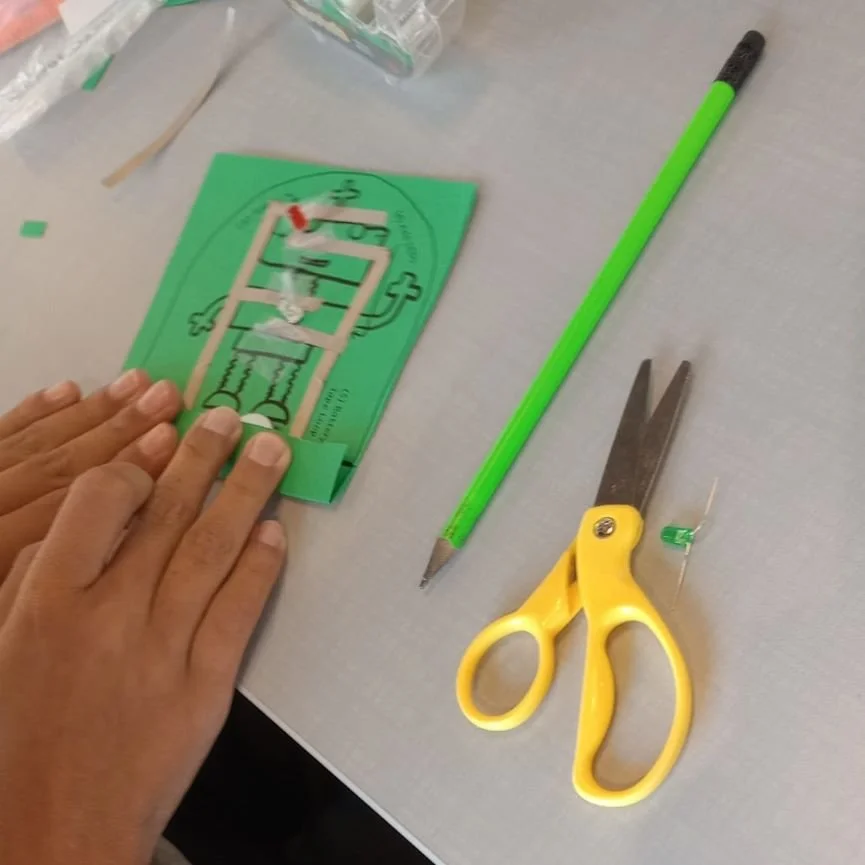
How to Use the Light-Up Templates
Do these steps in this order!
Cut out the shape first, following the solid lines.
Cut slots in order shown on the template.
Fold the dotted lines.
trace over the line first with pencil and a ruler to make a nice sharp crease.
Cover all tape lines with copper foil or fabric conductive tape.
Cut tape at an angle – use the point to peel the tape off the backing. Then fold the end of the backing down.
Attach the end of the tape to the end of the line. Pull the backing away slowly as you move up the line, pressing as you go.
Make sure to leave a gap:
between the positive and negative sides of the circuit
where LEDs go
where a switch goes.
Check that lines of tape and wires don’t touch or cross other lines of tape, unless shown on template.
Make sure your circuit is one continuous path of conductive tape.
Use one long piece for each section where possible.
To turn a corner:
Fold the tape backward at an angle, in the opposite direction you want to go.
Bring the tape over in the new direction.
Press the corner as flat as possible.
Overlap separate pieces you want to connect.
Overlap a row of short pieces to make a conductive pad for a switch.
Use the handle of your scissors to press the line down when you're done, especially the corners.
Next, place the LEDs over the conductive tape lines, matching positive and negative ends.
Seal the LED wires in with another layer of conductive tape.
Bend the wires if they are too long.
Press and cover with clear tape for extra hold.
Use a sticky-side-out loop of conductive tape to attach the battery to the circuit.
Hold the battery in place with:
another loop of conductive tape
a tab-in-slot pouch
a piece of a magnet sheet
a small binder clip.
Circuit Basics
What is Electricity? It is the movement of electrons.
Electrons are a part of atoms, the building blocks of the universe. They carry a negative charge.
Electrons can hop from one atom to another.
When they move, they carry energy that can be used to do work, like turn a motor or light an LED.
Circuits are paths of conductive material.
Conductive materials can lose electrons very easily.
Metal, water, graphite in lead pencils
For electricity to flow, you need a closed circuit.
Electrons need somewhere to go.
An open circuit is like an open drawbridge. No electricity can flow.
A closed circuit loops around.
A switch opens and closes a circuit, to turn it off and on.
A circuit needs a power source to start electrons moving.
Batteries are safe to use for paper circuits.
A circuit also needs a component that runs on electricity.
Lights, motors, speakers, etc.
Known as the circuit’s load.
A power source like a battery has a negative end (terminal) and a positive end.
Components have negative and positive ends too.
LEDs only work if the positive and negative ends match the battery’s ends.
This is called polarity.
Avoid short circuits!
Use insulation to prevent parts that should touch from touching. Insulating materials like paper and plastic do not carry electricity very well.
Always put a load in your circuit to prevent the battery from overheating.
Tips for Working with Conductive Tape
Start a line of tape
Cut a piece to the size you need or a little bigger.
Peel a little tape off the paper backing at one end, then fold the backing away.
Press the glue-y end down at the start of your line.
Keep pressing and peeling off the backing as you go.
Corners
Bend the tape at the corners if possible.
Stop at the corner
Fold the tape back at an angle, in the opposite direction from the new direction.
Fold the tape over in the new direction.
Press the lump at the corner as flat as possible.
Connect two pieces of tape
Overlap separate pieces so the conductive glue on the back can carry the electricity to the next piece.
If the tape doesn't have conductive glue (aluminum foil tape), fold over a tiny bit at the end, so the shiny part on the new piece is underneath where it can touch the shiny part of the old tape. Press down firmly.
Curves
Use thin tape (1/8th inch wide — cut wider strips in half)
Make tiny turns all along the curve, like with corners.
Reinforce and Insulate Circuit
Cover with clear tape, except for places where you need to make more connections.
Troubleshooting (if something doesn’t work)
Check for breaks:
Take another piece of tape and connect the battery and the LED directly.
Move the tester tape around to find the exact spot(s) that are disconnected.
Patch breaks with a new piece of tape that overlaps both ends.
Try a different battery or component.